
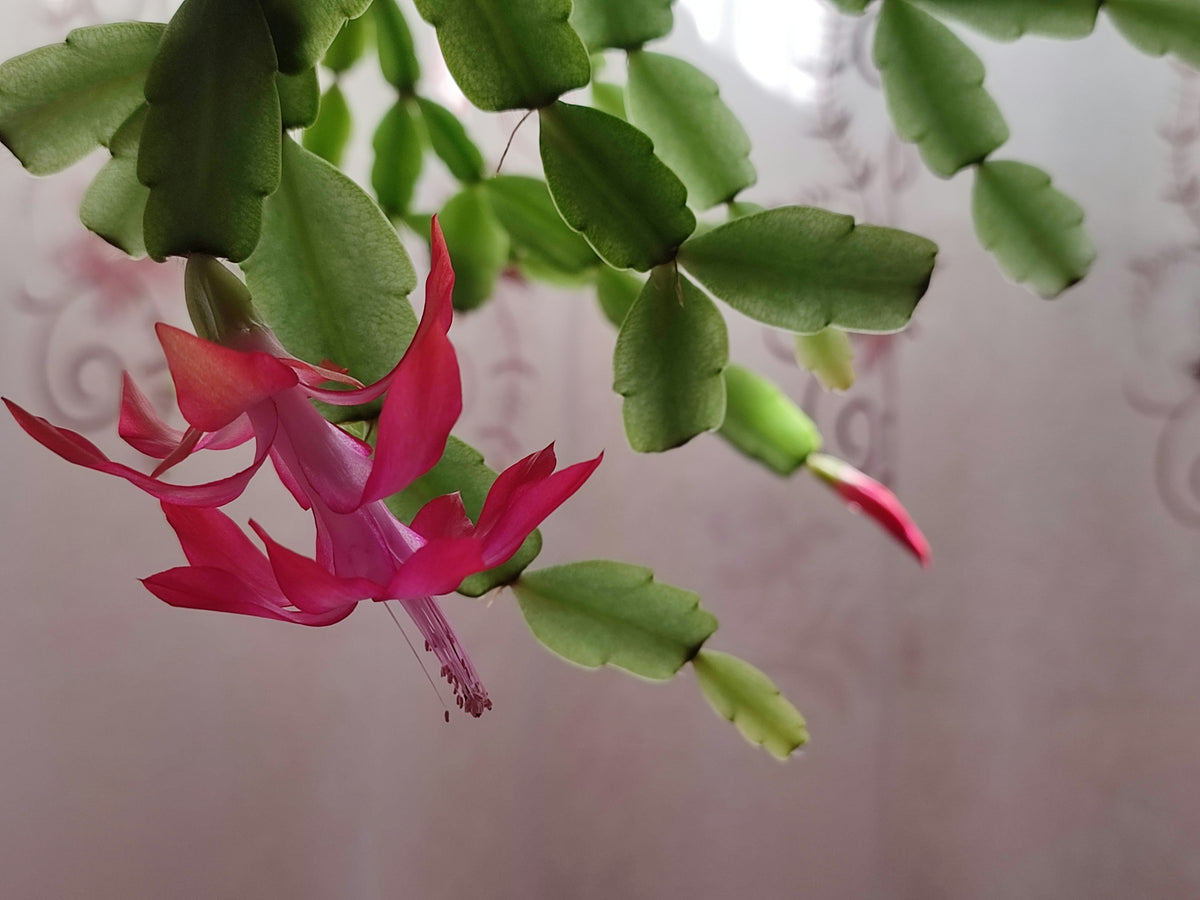
Look at the edges of the flat stem segments. A Thanksgiving cactus has pointed, claw-like teeth along the edges. A Christmas cactus has smooth, scalloped or teardrop-shaped edges with no points. An Easter cactus has rounded segments with slight ripples. Bloom timing is the second clue: Thanksgiving cactus flowers first, from mid-to-late November into December, Christmas cactus follows from late November or December on, and Easter cactus blooms in spring.
The three are close relatives and are often sold under the one name, "holiday cactus," so the tag on your plant may not tell you which it is. Here is how to check, what really differs between them, and what they have in common.
The Three at a Glance
- Thanksgiving cactus (Schlumbergera truncata): stem segments have pointed teeth, described as claw-shaped, and it blooms earliest. Iowa State University Extension gives a bloom window of mid-November to late December.
- Christmas cactus (Schlumbergera × buckleyi): stem segments are scalloped or rounded without points. Sources give different bloom windows: Iowa State says late November to early February, while University of Illinois Extension says late December to March.
- Easter cactus: stem segments are rounded or lightly rippled, and the flowers are star-shaped. It blooms mainly from March to May. Botanical names differ between sources, and extension guides use both Rhipsalidopsis gaertneri and Schlumbergera gaertneri.
The disagreement over Christmas cactus bloom dates is real. It reflects the fact that bloom time shifts with day length, night temperature, and your home, which we explain in our guide to getting a holiday cactus to bloom.
Check Your Plant in Three Steps
- Run a finger along the stem edge. Pointed teeth that you can feel mean Thanksgiving cactus. Smooth scallops mean Christmas cactus. Rounded, slightly rippled segments mean Easter cactus.
- Look at the flowers if there are any. University of Illinois Extension describes Easter cactus flowers as star-shaped and the other two as tubular, and adds that Thanksgiving cactus has yellow anthers while Christmas cactus has purplish-brown anthers. That is one source, so use it as a tiebreaker rather than the main test.
- Note when it blooms. An early-November bloom points toward Thanksgiving cactus and a March-to-May bloom points toward Easter cactus. Do not rely on timing alone, because conditions can shift it.
Does It Matter Which One You Have?
Day-to-day care is nearly the same, so you will not hurt the plant by guessing wrong. The difference that matters is the bloom plan. Penn State Extension says Christmas and Thanksgiving cacti need about six weeks of short days to bloom, while Easter cactus needs eight to twelve weeks, which is how it earned its name. If you expect holiday flowers from an Easter cactus, you will be waiting.
Care for All Three, in Brief
- Light: bright, indirect light. University of Florida Extension suggests placing it within about six feet of a south-, east-, or west-facing window.
- Water: when the upper inch of soil feels dry, and not letting the plant get too dry between waterings.
- Pot and soil: a well-drained mix, and a pot that is not too big, since holiday cacti prefer to be a little root-bound. Repot only when the plant has completely outgrown its container.
- Feeding: monthly during the growing season, and less in fall and winter.
Our guide to bright indirect light shows how to test a spot in your home.
Are They Safe for Pets?
The ASPCA lists Christmas cactus (Schlumbergera bridgesii), under the common names Christmas cactus and Easter cactus, as non-toxic to dogs, cats, and horses. The entry we read does not name Thanksgiving cactus separately, so confirm your plant's botanical name before you rely on it. As the ASPCA notes, eating any plant material can cause vomiting and stomach upset in dogs and cats. Our pet-safe and toxic houseplant guide explains how to check a plant against a veterinary source.
Common Mix-Ups
- Trusting the label. Many plants are sold simply as "Christmas cactus" or "holiday cactus," so use the stem edges.
- Assuming a plant is broken because it blooms early or late. Bloom time moves with night length and temperature.
- Mixing up flower colors with types. Colors vary within a type, so color does not tell you which one you have.
From the Greenhouse Bench
We list a Holiday Cactus (Schlumbergera) in 4-inch pots in several colors, and a Spring Cactus (Rhipsalidopsis), the Easter type, in several sizes. Our holiday cactus listing does not name a species, which is why we recommend the stem-edge check above rather than guessing from the tag. You can see them on our holiday cactus page and our spring cactus page, or browse all holiday and spring cacti.
Frequently Asked Questions
Which one is the "real" Christmas cactus?
Extension sources use Schlumbergera × buckleyi for Christmas cactus and Schlumbergera truncata for Thanksgiving cactus. The two are close relatives, and both are often sold as Christmas cactus.
Can a Thanksgiving cactus bloom at Christmas?
Yes, conditions can move bloom time. Longer nights and cooler air bring buds on sooner, and a warm or brightly lit room can delay them. Our bud-set plan walks through it.
Is an Easter cactus harder to care for?
Not harder, just different. It blooms in spring and needs a longer short-day period to set buds.
Do the three need different potting mix?
The extension guidance we reviewed gives the same advice for all three: a well-drained mix and a pot that fits the root ball.
The Short Version
Pointed teeth mean Thanksgiving, scallops mean Christmas, and rounded segments mean Easter. Once you know which you have, you can plan for the bloom.
Sources: Iowa State University Extension: All About Holiday Cacti, University of Illinois Extension, University of Wisconsin Extension: Holiday Cactus, Penn State Extension, UF/IFAS Gardening Solutions, and the ASPCA Christmas cactus entry. Photo: Ruslana Mushtyn on Unsplash.